
 Benji Visser
Quick answer
The alternatives are a Health Spending Account, a pooled association plan, employer-funded individual coverage, a hybrid of an HSA plus a thin insured plan, a Wellness Spending Account, and no plan at all. For most teams under 15 with moderate, predictable health spending, an HSA alone or with a thin insured layer wins on cost and flexibility.
Why small businesses look past group insurance
The first problem is the premium. A conventional plan charges per employee per month whether anyone claims or not, and the renewal usually goes up. The second problem is fit. Most group products are built for 50 or more employees. A team of four runs into minimum headcounts, medical underwriting, and a benefits booklet nobody uses in full.
So the question is not "insurance or nothing". It is which of the options below covers the health costs your team actually has, at a price the business can justify.
Option 1: Health Spending Account (HSA / PHSP)
An HSA is the plain-language name for a Private Health Services Plan under the Income Tax Act. You set a dollar limit per employee for the year. When an employee has a CRA-eligible medical expense, the business reimburses it and pays an admin fee. There is no premium. If nobody claims, the business spends nothing.
When the plan is set up properly, reimbursements are not a taxable benefit to the employee and are deductible to the business. The CRA publishes the list of eligible medical expenses and the PHSP rules. This is not the US health savings account; the name is the only thing they share.
Two provincial details matter. Quebec treats HSA reimbursements as a taxable benefit provincially. Ontario charges 8% RST and a 2% premium tax on each claim, which we explain in taxes on your HSA invoice.
An HSA works for a one-person corporation and up. Unincorporated sole proprietors without employees face deduction limits of $1,500 per adult and $750 per child; incorporated owners do not.
Option 2: Pooled or association plans
The Chambers of Commerce Group Insurance Plan and various industry association plans sell insurance to businesses too small for a conventional group plan. There is no minimum headcount and rates are pooled across members, so a three-person firm can get real insurance.
You are still paying premiums every month, and the plan design is the insurer's, not yours. This is the right option when you want pooled protection against large claims and your team is too small for a standard plan. It solves a different problem from an HSA: it spreads risk, where an HSA sets a budget.
Option 3: Individual coverage plus an HSA or allowance
Employees can buy their own individual health insurance, and the business helps pay for it. There are two ways to do that. The business can reimburse the premiums through the HSA, since premiums for private health plans are an eligible medical expense, or it can pay a taxable health allowance on top of salary.
The HSA route is worth more to the employee after tax. The allowance is simpler but taxed as income. Either way, the protection against a big expense comes from the policy the employee bought, not from the employer's contribution.
Option 4: Hybrid, an HSA plus a small insured plan
A hybrid gives each tool one job. The HSA pays everyday eligible expenses up to the limit. A stripped-down insured plan covers the risks a spending limit cannot: catastrophic drugs, disability, life, and travel. You skip the premiums for dental, vision and paramedical categories that most small teams underuse, and keep insurance where pooling matters.
This is the shape we see most often when a business leaves a full group plan but is not comfortable with no insurance at all.
Option 5: Wellness Spending Account
A Wellness Spending Account covers gym memberships, equipment, courses and other wellness spending that an HSA cannot. The trade-off is tax: WSA reimbursements are a taxable benefit to the employee. Businesses usually offer a WSA alongside an HSA rather than instead of one. Our HSA vs WSA comparison covers the details.
Option 6: No plan, employees claim the tax credit
The last option is to offer nothing and let employees claim the Medical Expense Tax Credit on their own returns. For most owners this is the weakest choice. The credit is non-refundable, it only applies above a threshold, and it is worth less than a deductible employer plan. It also leaves you with no benefit to point to when hiring.
How the options compare
| Option | Who pays what | Tax treatment | Minimum size | Risk pooling | Admin effort | Typical cost |
|---|---|---|---|---|---|---|
| HSA / PHSP | Business pays approved claims plus a fee | Deductible to business, tax-free to employee (Quebec differs) | 1 | None | Low | Claims plus 8% fee, no premiums |
| Pooled / association plan | Business pays monthly premiums | Premiums deductible | 1 | Yes | Low | Monthly premium per employee |
| Individual coverage plus HSA | Employee buys policy, business reimburses premiums | Tax-free via HSA, taxable as allowance | 1 | Yes, per policy | Medium | Premium reimbursed plus fee |
| Hybrid (HSA plus thin insured) | Claims plus a small premium | Both deductible | 1 to 3 | Partial | Medium | Lower premium plus claims |
| Wellness Spending Account | Business pays approved claims plus a fee | Taxable benefit to employee | 1 | None | Low | Claims plus fee |
| No plan (tax credit) | Employee pays, claims credit at tax time | Non-refundable credit | n/a | None | None | $0 to business |
Worked example: a five-person incorporated firm
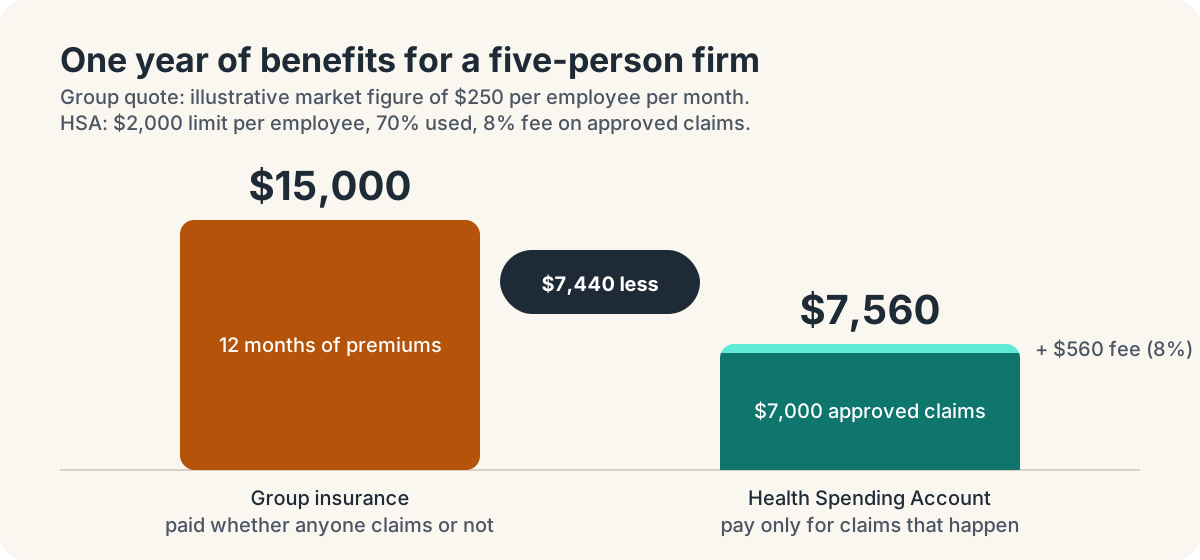
Take a five-person incorporated firm quoted about $250 per employee per month for group insurance. That is an illustrative market figure, not a Frontier number. The alternative is an HSA with a $2,000 limit per employee and an 8% admin fee, and we will assume the team uses 70% of its limit.
Group insurance: $250 × 5 employees × 12 months = $15,000 a year, claims or no claims.
HSA: $2,000 × 5 employees = $10,000 of available limit. At 70% usage, approved claims are $7,000. The 8% fee on those claims is $560. Total: $7,560.
The difference is $7,440 for the year, before any Ontario RST and premium tax on the HSA claims. If the team uses the full $10,000, the HSA costs $10,800, still $4,200 less than the premiums. Only at usage above the limit would the comparison flip, and the limit stops that from happening.
What the example leaves out matters too. The $15,000 plan probably includes some disability, life or drug coverage the HSA does not. If the team needs those, add the cost of a thin insured layer to the HSA side before deciding.
Where an HSA is the wrong answer
An HSA alone is the wrong answer when the team needs disability, life, or high-cost specialty drug coverage. Those are pooled risks, and a spending limit cannot absorb a $40,000 drug bill. Employees with chronic conditions whose costs reliably exceed any sensible limit are better served by insurance. And some owners simply want a fixed monthly bill for budgeting; an HSA's cost moves with claims, even though the annual limit caps it.
In those cases we would tell you to buy insurance, either a pooled plan or a hybrid, and use an HSA only for the leftovers.
What we recommend
For most Canadian businesses under about 15 people with predictable, moderate health spending, an HSA on its own, or an HSA plus a small insured layer for the catastrophic risks, beats a full group plan on cost and flexibility. You set the budget, you pay only for claims that happen, and employees choose what to spend on.
Frontier HSA is built for that route. There are no premiums and no setup or monthly fees; we charge 8% of approved claims, there is no minimum headcount, and you can start with one employee. If your team needs disability, life or specialty drug coverage, buy that first and let the HSA handle the rest.
FAQ
Is an HSA a replacement for group insurance?
For everyday medical, dental and vision expenses, yes. An HSA reimburses CRA-eligible claims up to the limit you set. It does not pool risk, so it does not replace disability, life, travel or catastrophic drug coverage. Teams that need those buy a small insured plan alongside the HSA.
Can a one-person corporation have an HSA?
Yes. An incorporated owner who is also an employee of the corporation can set up a Private Health Services Plan with one member. Frontier has no minimum headcount. Unincorporated sole proprietors with no employees face deduction limits of $1,500 per adult and $750 per child, so the business structure matters.
Are HSA reimbursements taxable?
Federally, no. When the plan qualifies as a PHSP, reimbursements of eligible medical expenses are not a taxable benefit to the employee, and the business deducts the cost. Quebec treats the reimbursement as a taxable benefit provincially. Ontario adds 8% RST and a 2% premium tax to each claim.
Can I offer an HSA and group insurance together?
Yes, and many small businesses do. The insured plan covers the risks a spending limit cannot, such as disability, life, travel and high-cost drugs. The HSA covers deductibles, co-pays, dental overages, vision and therapy. You can also keep the insured plan small and let the HSA do most of the work.
What does an HSA cost compared with premiums?
Group insurance costs the same every month whether anyone claims or not. A pay-as-you-go HSA costs only the approved claims plus the admin fee. Frontier charges 8% of approved claims with no premiums, setup fees or monthly fees, so a $1,000 claim costs the business $1,080 before any provincial tax.
Do I need a minimum number of employees?
Not for an HSA. Frontier plans start at one employee. Conventional group insurance often wants three or more lives and prices small groups higher. Pooled plans such as the Chambers of Commerce Group Insurance Plan accept very small groups too, but they still charge premiums rather than paying claims as they come.
Related reading
- HSA vs group insurance in Canada -- The two models side by side
- HSA pros and cons in Canada -- The honest trade-offs before you switch
- Small business HSA guide -- Costs, claims, family coverage and CRA compliance