 Benji Visser
Quick answer
Yes. A Canadian HSA can be set up with no deposit, no float and no money moved until an employee's claim is approved. Some providers ask for prefunding or a deposit, and that is a cash-flow rule, not a legal requirement. With Frontier the first dollar leaves the business after the first approved claim, and a quiet year costs nothing.
What funding means for an HSA
A Health Spending Account is not the American savings account with the same initials. The business sets a claim limit for each employee, which is a ceiling on what that employee can claim in the plan year. The limit is not money set aside. If you are new to the account itself, start with what a Health Spending Account is.
Funding is the separate question of how the business pays for a claim once it is approved. A provider can bill for each claim, ask for money upfront, or sell credits inside a group plan. That choice decides when cash leaves the business. The CRA's Private Health Services Plan rules say nothing about prefunding, so any deposit a provider asks for comes from its own rules.
Model 1: pay per claim
This is what Frontier does. An employee pays for an eligible expense, submits the receipt, and we review it. Once the claim is approved we reimburse the employee, then invoice the corporation for the claim, the 8% administration fee and applicable taxes. Nothing is held on deposit.
The corporation pays the invoice from its business bank account, or turns on automatic bank payments so each approved claim is debited as it happens. Automatic payments are set up once, with a bank verification that uses two small deposits. That verification is not a balance; it only confirms the account.
Model 2: prefunding or a deposit
Some providers ask for money before they will pay claims, or ask the business to keep a balance topped up. The cash sits with the provider until it is used. How much goes in is the provider's rule, and it is not always the full annual limit for every employee.
That can work when claims are steady and the business has cash to spare. For a four-person corporation in a quiet year, the deposit is dead money: it left the account before there was anything to pay, and the provider's terms decide how and when the unused part comes back.
Model 3: credits inside a group plan
Inside a group benefits plan the same account is usually called an HCSA. The insurer sets a credit per employee and bills it with the premium, often whether or not anyone uses it. A quiet month can still bring a bill. This model is a top-up for businesses that already have a group plan; it is not a way to avoid upfront money.
Two plans can show an employee the same amount while asking the corporation to pay at very different times. With group-plan credits, ask how the premium is billed and what happens to unused credits.
What happens to money nobody claims
With pay-per-claim funding there is no deposit to get back. If nobody submits an approved claim, no money moves and there is nothing to refund. With Frontier there are also no setup, monthly or annual fees, so a quiet year costs nothing, as the true cost post works through.
With prefunding, ask how and when an unused balance is returned, and whether fees were taken from the deposit before any claim used it. With group-plan credits, ask whether unused credits are refunded or carried over. A credit carried into next year is not cash back in the corporation's account.
A worked first month for a four-person corporation
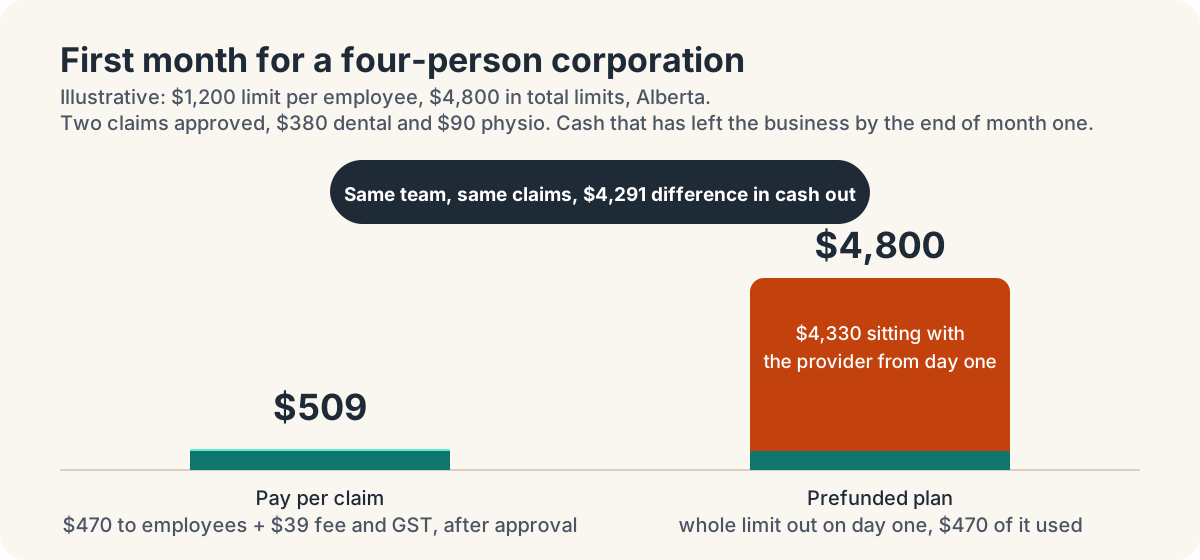
Take an Alberta corporation with four employees and a $1,200 limit each, so $4,800 in total limits. Every number is an illustration. In the first month one employee claims $380 of dental and another claims $90 of physio. The other two claim nothing.
With pay-per-claim billing there are two invoices. The dental one is $380 plus a $30.40 fee plus $1.52 of GST on the fee, $411.92 in total. The physio one is $90 plus a $7.20 fee plus $0.36 of GST, $97.56. Together, $509.48 leaves the business, after the claims. Nothing moves for the unused limits. Alberta charges no tax on the claim itself, so only the GST on the fee applies; an Ontario corporation would also see RST and the premium fee.
Now suppose a prefunded provider wants the full $4,800 at the start. That amount leaves the corporation on day one. Only $470 of it goes to the month's claims, and $4,330 sits with the provider. The difference is not the fee, which depends on the provider; it is when the money moves.
When prefunding is fine, or better
Prefunding is reasonable when claims are steady and predictable and the business has no cash-flow worry. Some owners would rather make one transfer a year than pay invoices as they come, and that is a fair reason to choose it.
An existing group plan changes the picture too. If you already pay an insurer every month, adding spending credits to that plan can be simpler than running a separate account, even though the credits are billed whether or not they are used. The choice follows your cash flow and your current benefits setup, not a rule that every HSA needs a pot of money on day one.
What to ask a provider before you sign
- Do I pay anything before the first claim? A deposit, the full annual limits or a balance to keep topped up are three different answers.
- What triggers a charge? An approved claim, a funding schedule, or a premium that arrives whether anyone claims or not.
- Is the fee charged on approved claims or on the deposit? And are there setup, monthly or annual fees on top? The hidden fees post lists what to look for.
- Who reimburses the employee, and how does the corporation pay? Manual invoices, pre-authorized debit, or both.
- How does the money come back if nobody claims? When, how, and with the fee already taken or not.
- What are the payment terms on an invoice? No upfront funding is not the same as paying whenever you like.
The three models side by side
| Pay per claim | Prefunding or deposit | Credits in a group plan | |
|---|---|---|---|
| Money out before the first claim | None | The deposit or balance the provider sets | Billed with the premium |
| In a quiet year | Nothing to pay | The balance sits with the provider | Credits are often billed anyway |
| How the fee is charged | On each approved claim (8% at Frontier) | On claims or on the deposit, ask which | Inside the premium |
| Who it suits | Small teams with uneven claims | Steady claims and spare cash | Businesses that already have a group plan |
What we recommend
For a Canadian corporation with a handful of employees and uneven claims, pay-per-claim funding is the right default, because no cash leaves the business until there is an approved receipt, and a quiet year costs nothing.
Frontier charges 8% of approved claims, with no setup, monthly or annual fees, no deposit and no minimum balance. The corporation pays each invoice from its business account or turns on automatic bank payments, and we pay the employee either way; the whole flow is on how it works. If your claims are steady and you would rather make one transfer a year, or you already have a group plan and only want a top-up, prefunding or a plan credit can suit you better.
FAQ
Do I have to deposit money to start an HSA?
No. A Canadian HSA can be set up without a deposit. Some providers ask for one under their own funding rules, and that is their choice, not a legal requirement. Frontier asks for nothing upfront. Setting an employee's limit does not mean the corporation sends that amount anywhere.
Is pre-authorized debit required?
Not with Frontier. The corporation can pay each invoice by hand from its business bank account, or turn on automatic bank payments so approved claims are debited as they happen. Automatic payments are set up once with a bank verification using two small deposits. There is no balance to keep topped up either way.
Who pays the employee, me or the provider?
Frontier does. Once a claim is approved we reimburse the employee, then invoice the corporation for the claim, the 8% fee and applicable taxes. The employee never waits on the corporation's payment, and the corporation never has to run a reimbursement through payroll.
What if the business cannot pay an invoice right away?
Ask any provider for its payment terms before you sign, because pay-per-claim says when billing starts, not that an invoice can sit. With Frontier, the invoice for each approved claim is due on its own terms like any supplier invoice, and automatic bank payments remove the question entirely.
Can I switch from a prefunded plan to pay-per-claim?
Usually, at the end of the plan year or when the contract allows. Before you move, ask the current provider how and when the unused balance comes back and whether fees were already taken from it. A new pay-per-claim plan has nothing to transfer in, so it can start the day the old one ends.
Does the CRA require an HSA to be funded in advance?
No. The CRA's Private Health Services Plan rules cover what can be reimbursed and who can be covered. They say nothing about deposits or prefunding. Funding is the provider's choice, so a deposit requirement is that provider's policy, and a plan with no deposit is just as valid.
Related reading
- The true cost of an HSA for a small business -- Three worked years at 8%, including the one where nobody claims
- Frontier HSA pricing -- 8% of approved claims, nothing else
- Small business HSA guide -- Costs, claims, family coverage and CRA compliance