
 Benji Visser
Quick answer
A Health Spending Account costs the claims your team actually makes, plus an admin fee (8% at Frontier), plus taxes that depend on the province. There are no premiums. In a year with no claims it costs nothing. The only way to pay more than you expect is to mistake the limit for a bill: it is a ceiling, not an amount you send anywhere.
What you pay for, and what you do not
An HSA, or Private Health Services Plan in the Income Tax Act's words, is a simple arrangement. The business sets a yearly limit per employee. An employee pays for an eligible expense, submits the receipt, and the business reimburses them through the plan. Inside a group benefits plan the same thing is sometimes called an HCSA. It is not the American savings account with the same initials.
Three things show up on the invoice:
- Approved claims. The money that goes back to the employee for CRA-eligible medical expenses: prescriptions, dental, glasses, physio, massage and the rest of the eligible list.
- The admin fee. Frontier charges 8% of the approved claim. On a $1,000 claim, that is $80.
- Taxes. GST or HST on the fee everywhere, and in Ontario two extra taxes on the claim itself. More on that below.
Three things do not show up, at least not with us: premiums, unused limits, and setup, monthly or annual fees. Some providers do charge a setup fee, a yearly fee or a per-employee fee. Those are real costs and they land in the quiet years too, so ask for the full fee list before you compare headline percentages.
The limit is a ceiling, not a bill
This is the misunderstanding we clear up most often. A $1,500 limit per employee means an employee can claim up to $1,500 of eligible expenses in the plan year. It does not mean the business pays $1,500 per employee. If someone claims $400, the business pays $400 plus the fee and taxes on $400. If someone claims nothing, the business pays nothing for that person.
So the limit is your worst case, and you choose it. Six people at $1,500 means the most the business can ever reimburse in the year is $9,000. The year will usually come in well under that, because not everyone needs new glasses, a crown and a dozen physio visits in the same twelve months.
What one $1,000 claim costs, by province
The cleanest way to understand the cost is to follow one claim. An employee submits a $1,000 dental receipt and it is approved. The employee receives $1,000 in every province. What the business pays depends on where the corporation is.
In Ontario the invoice is $1,192: the $1,000 claim, the $80 admin fee, $80 of retail sales tax (8% on the claim), a $21.60 premium fee (2% on the claim plus the fee) and $10.40 of HST on the fee. The extra $192 is the fee plus the province's taxes.
In Alberta or B.C. the invoice is $1,084: the $1,000 claim, the $80 fee and $4 of GST on the fee. Nothing is charged on the claim itself. Saskatchewan, Manitoba and Yukon work the same way. In the Atlantic provinces HST on the fee makes it $1,091 to $1,092.
Outside Ontario, then, the taxes are a few dollars per claim. Ontario is the one place where the taxes matter to the total, which is why the worked example below uses an Ontario team. The full line-by-line table for every province is in our post on RST, GST/HST and the premium fee.
Three years for the same six-person team
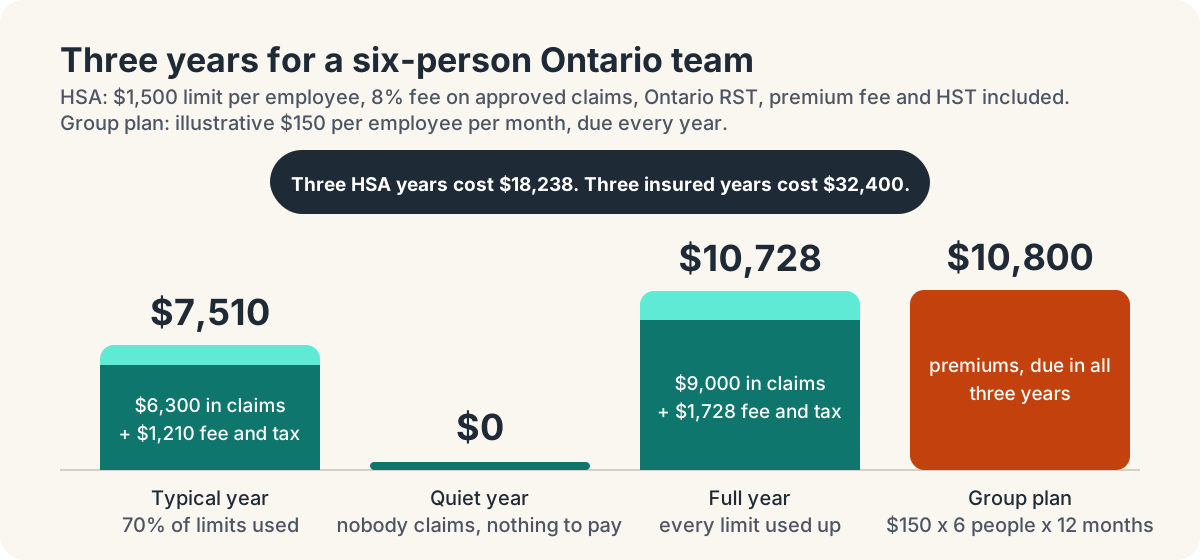
Take a six-person Ontario corporation with a $1,500 limit per employee, so $9,000 in total limits. Every number here is an illustration, not a quote, and the fee is 8%.
Year 1, a typical year. The team uses 70% of its limits, which is $6,300 in approved claims. The admin fee is $504. Ontario RST on the claims is $504. The premium fee on the claims plus the fee is $136.08. HST on the fee is $65.52. The year costs $7,509.60, and the employees received $6,300 of it.
Year 2, a quiet year. Nobody claims. There are no approved claims, so there is no fee and no tax. The year costs $0. The limits were there the whole time, and nobody needed them.
Year 3, a full year. Everyone uses the whole $1,500, so $9,000 in approved claims. The admin fee is $720, RST is $720, the premium fee is $194.40 and HST on the fee is $93.60. The year costs $10,728, the most this plan can ever cost at this limit.
Move the same team to Alberta or B.C. and the three years cost $6,829.20, $0 and $9,756, because only the GST on the fee is left.
The same team on group insurance
Now put the same six people on an insured health and dental plan. Say the premium is $150 per employee per month, an illustration again, since small-group premiums vary a lot by province, plan design and the team's age. That is $10,800 a year.
The difference is not the size of the number. It is that the $10,800 is due in all three years. The quiet year still costs $10,800. The typical year costs $10,800. And in the year after that, the carrier sends a renewal letter and the number goes up, for reasons we covered in how to avoid group insurance premium increases. Over our three illustrative years the HSA costs $18,238 and the insured plan costs $32,400, before any renewal increase.
Add the business's own money back in and the picture is the same. In three years the HSA put $15,300 into employees' hands and cost $18,238. The insured plan cost $32,400 and paid out whatever the team claimed, which for a small group is usually well below the premium.
Where group insurance is cheaper
An HSA is not cheaper for everyone, and the full year above shows why. Three cases where we would tell you to keep insurance, or add it:
- Someone on the team has heavy, ongoing drug costs. A biologic or a specialty drug can run past any limit a small business can afford. Insurance spreads that cost across thousands of other groups. An HSA does not, so the employee hits the ceiling and pays the rest.
- You need life, disability or travel coverage. An HSA reimburses medical expenses. It does not pay a salary during a long illness or a lump sum to a family. Those are insurance products, and they are worth buying on their own.
- An Ontario team that uses its full limit every year. At full use the HSA year costs $10,728 in our example, close to the $10,800 premium, and the premium bought coverage with no ceiling. If your team really does max out every year, the comparison is a coin flip and the insured plan's predictability may be worth more to you.
Most small teams are not in those cases. Their claims are uneven: a big dental year here, a quiet year there, two people who never claim at all. That pattern is where paying only for what happens wins.
The three years side by side
| Year | HSA, Ontario team | HSA, Alberta or B.C. team | Group plan, illustrative | What employees received |
|---|---|---|---|---|
| Typical year, 70% of limits used | $7,510 | $6,829 | $10,800 | $6,300 |
| Quiet year, no claims | $0 | $0 | $10,800 | $0 |
| Full year, every limit used | $10,728 | $9,756 | $10,800 | $9,000 |
| Three-year total | $18,238 | $16,585 | $32,400 | $15,300 |
The group plan column assumes the premium does not rise. It usually does.
Cash flow: when the money leaves
With Frontier the business pays after each claim is approved. One invoice covers the reimbursement, the 8% fee and the taxes, and nothing is paid upfront. There is no float to top up and no deposit to make before the first employee can claim. Some providers do ask for a deposit or for the plan to be prefunded, which ties up cash in the quiet months. That is a cash-flow rule rather than a cost, but for a four-person corporation it can be the difference between signing and not. We will cover the funding models in their own post.
How the tax treatment works
For the corporation, the approved claims and the admin fee are a deductible business expense, the same as premiums would have been. For the employee, the reimbursement is not taxable income, because the plan is a Private Health Services Plan and the expenses are on the CRA's eligible list. The one exception is Quebec, where the reimbursement is a taxable benefit on the provincial side. The full treatment, including what to do about owner-employees, is in our HSA tax guide for corporations.
What we recommend
For a Canadian corporation under about 25 people with normal, uneven health spending, an HSA costs what the team uses plus 8% plus provincial taxes, and nothing in a quiet year. That beats a fixed premium in most years, and the business sets the ceiling.
Frontier HSA charges 8% of approved claims, with no setup, monthly or annual fees, no minimum headcount and nothing paid upfront. We would tell you to keep or add insurance if someone on the team has heavy ongoing drug costs, or if you need life, disability or travel cover, which an HSA does not do.
FAQ
Do I still pay for an HSA when nobody claims?
Not with Frontier. The invoice is approved claims plus the 8% fee plus taxes, so a year with no approved claims is a year with no invoice. Providers that charge setup, monthly or annual fees do bill in a quiet year, so check the fee list before you sign.
Is the HSA limit money I have to set aside?
No. The limit is the most an employee can claim in the plan year. It is not a deposit and it is not a bill. You pay only when a claim is approved, and an unused limit costs nothing. Some providers ask for prefunding or a deposit, which is a cash-flow rule, not a cost of the plan.
What does a $1,000 HSA claim cost in Ontario?
About $1,192 at an 8% fee. The employee receives $1,000. The business pays the $80 admin fee, $80 of Ontario RST on the claim, a $21.60 premium fee on the claim plus the fee, and $10.40 of HST on the fee. In most other provinces the same claim costs $1,084 to $1,092.
Are there hidden HSA fees?
There can be. Setup fees, annual fees, per-employee fees, card fees and prefunding rules all change the yearly total without changing the headline percentage. Frontier charges 8% of approved claims and nothing else. Ask any provider for a sample invoice for a $1,000 claim in your province.
Is the 8% admin fee tax deductible?
Yes. For a corporation the approved claims and the admin fee are a business expense, the same as premiums would be. The employee receives the reimbursement free of federal tax. In Quebec the reimbursement is a taxable benefit on the provincial side.
Can I lower the cost by lowering the limit?
Yes, and it is the one lever you fully control. The limit caps what any employee can claim in the year, so it caps your worst case. Set it where the business is comfortable, raise it when a year goes well, and remember that a lower limit only lowers the bill in years when people hit it.
Why is an HSA more expensive in Ontario?
Ontario charges 8% retail sales tax on the claim amount and a 2% premium fee on the claim plus the admin fee, and HST applies to the fee. Together they add about 11 cents to every dollar claimed, on top of the admin fee. No other province taxes the claim itself.
Related reading
- Frontier HSA pricing -- 8% of approved claims, nothing else
- Hidden HSA fees to compare -- Setup, annual and employee fees, funding rules and claim speed
- Taxes on your HSA invoice -- RST, GST/HST and the premium fee, province by province