
 Benji Visser
Quick answer
A Canadian small business has five ways to push back on a group benefits renewal: ask the carrier to show its math, shop the plan around to other Canadian carriers, trim the plan, split the premium with employees, or replace insured health and dental with a Health Spending Account. Only the last one removes the increase for good, because an HSA has no premium to increase.
Why the renewal goes up every year
Provincial health insurance (OHIP, MSP, AHCIP, RAMQ and the rest) pays for doctors and hospitals. Your group plan pays for what the province does not: prescription drugs, dental, glasses, and visits to the physio, massage therapist or counsellor. Those costs rise every year across the country, and the carrier adds that rise to every renewal whether your team used the plan or not.
Your own claims are only part of the price. The carrier also charges every group a share of the very large claims it pays out across all its customers, and it builds the advisor's commission into the premium. A quiet year at your company does not make the price go down.
Small groups feel it more. With 5 or 15 employees, one person's bad year is not spread across a big pool, so the renewal follows your own claims up. Renewals in the high single digits to low teens are common, and the letter rarely explains why.
Lever 1: Ask how they got the number
The renewal letter gives you a price. Behind it is a worksheet that shows how the price was built: how much of last year's premium went out as claims, how much was added for rising costs, what the carrier charged for sharing big claims, and what the advisor is paid. Ask for it. Every line is a number someone chose, and each one can be questioned.
If your team claimed little, say so and ask why the full cost-of-living bump still applies. Commission is usually a percentage of premium, and Canadian carriers have agreed through their industry body, the CLHIA, to disclose what the advisor earns on your plan. Ask whether that should go up just because the premium did. This usually knocks a few points off. It does not stop the same letter from arriving next year.
Lever 2: Shop the plan around
Take your plan to other Canadian carriers for quotes. For a small group that usually means two or three of Sun Life, Manulife, Canada Life, Desjardins, Green Shield, Equitable, Empire Life or your provincial Blue Cross, plus a pooled option like the Chambers of Commerce Group Insurance Plan. A new carrier often prices a small group below its current renewal to win the business, so the first year can be cheaper for the same coverage.
The gain is usually one year. At the next renewal the new carrier reprices on your group's own claims and the cycle starts again. Shopping around changes who sends the letter. It does not change the fact that one arrives.
Lever 3: Trim the plan
The premium drops when the plan pays less. Raise the deductible, have employees pay a bigger share of each claim, cap physio and massage per visit or per year, drop the parts nobody uses, or limit the drug plan to generics and a shorter list of covered drugs.
Check what the province already pays for before you cut. Ontario's Trillium Drug Program, BC's Fair PharmaCare and Alberta's non-group coverage all pick up high drug costs above an income-based deductible. In Quebec, a group plan that covers drugs has to match the RAMQ public plan at minimum, so trimming has a floor there.
Dropping an unused benefit costs the team nothing. Making them pay more per claim costs them every time they go to the dentist, so be honest about which one you are doing. Trimming brings this year's bill closer to budget, but the plan that is left still renews, and the yearly bump still applies to it.
Lever 4: Split the premium with employees
Many Canadian employers split the premium, with the business paying somewhere between half and all of it. Moving from 100% to 80% employer-paid cuts your bill by a fifth without changing the plan. There is a small tax wrinkle that softens it: the health and dental premiums an employee pays through payroll count toward the federal Medical Expense Tax Credit, and employer-paid health and dental premiums are not a taxable benefit outside Quebec.
The trade-off is morale. A payroll deduction that goes up every year is a visible pay cut, and the employee did not get a say in the renewal. Splitting the premium moves the increase. It does not remove it.
Lever 5: Replace health and dental with an HSA
In Canada an HSA is a Private Health Services Plan under the Income Tax Act, not the American savings account that shares the name. Instead of paying a premium, the business sets an annual limit per employee and pays back CRA-eligible medical expenses as they happen, plus an admin fee. No claims, no cost. There is no premium, so there is no renewal and no letter.
Set up properly, the money an employee gets back is not taxed as income, and the business deducts the cost. The CRA keeps the list of eligible medical expenses on canada.ca. Quebec treats HSA reimbursements as a taxable benefit provincially. Ontario charges 8% RST and a 2% premium tax on HSA claims, which we cover in our post on HSA premium taxes.
An HSA does not spread risk across other companies. Keep life, disability and travel insured if the team needs them. Those lines are cheap next to health and dental, which is where most of the premium, and most of the increase, lives.
The hybrid: a small insured plan plus an HSA
Most teams that move do not drop insurance entirely. They keep a small insured plan for life, disability, travel and very expensive drugs, and put everything else through the HSA.
This suits a business that wants protection against one huge claim but is done with the yearly creep on routine benefits. The insured piece still renews, but the increase lands on a bill that is a fraction of the old one. The HSA side never renews.
How the five levers compare
| Lever | How much it saves | How long it lasts | Effort | Risk to employees |
|---|---|---|---|---|
| Ask for the math | A few points off the increase | This renewal | A meeting with your advisor | None |
| Shop the plan around | Often more than asking, first year | Usually one year | Quotes, forms, a switch | New carrier, new booklet, possible health forms |
| Trim the plan | Depends on what you cut | Until the next bump | A plan change | Paying more per claim, or lost coverage |
| Split the premium | Your share drops, the total does not | Until the next increase | Payroll change | A deduction that rises every year |
| Move to an HSA | The whole premium, replaced by claims | Permanent, no renewal | Setup, notice to carrier | Annual limit, no cover for one huge claim |
Worked example: an eight-person incorporated firm
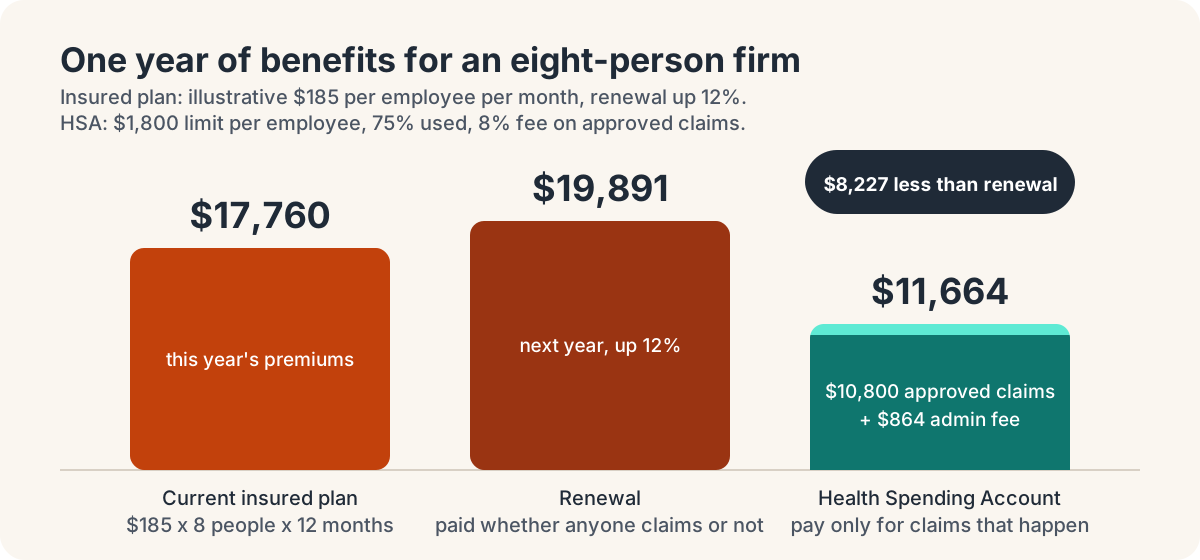
Take an eight-person incorporated firm in Calgary with insured health and dental at an illustrative $185 per employee per month. The renewal comes in at an illustrative 12% more. Both figures are for the example, not a quote from any carrier.
This year: $185 × 8 employees × 12 months = $17,760, claims or no claims.
Renewal year: $17,760 × 1.12 = $19,891, an extra $2,131 for the same plan.
HSA instead: a $1,800 limit per employee is $14,400 of available limit. At 75% usage, approved claims are $10,800. The 8% fee on those claims is $864. Total: $11,664.
The difference is $8,227 for the year against the renewal, and $6,096 against what the firm pays today. If every employee used the full limit, the HSA would cost $15,552, still $4,339 under the renewal. An Ontario firm would add RST and premium tax to the HSA side, and a small insured plan for life and disability would add to it too. Even so, the limit caps the cost, and nothing in it goes up next year on its own.
Where you should keep the insured plan
Some teams should take the increase and stay. If an employee has an expensive ongoing prescription, a fixed annual limit is not a substitute for drug coverage. Keep a drug plan for that person, or run the hybrid.
Stay insured if the team values a fixed monthly cost over a variable one, if a collective agreement or employment contract promises a specific insured plan, or if you are above about 25 employees, where Canadian carriers start to price you more on the pool than on your own claims and renewals get calmer. Our post on HSA pros and cons goes through the trade-offs in full.
What we recommend
For a Canadian business under about 25 people whose renewal keeps rising, move health and dental to an HSA and keep only the pieces that protect against a huge claim insured. That ends the renewal cycle for the benefits that drive the increase, because there is no premium to increase.
Frontier HSA charges 8% of approved claims, with no premiums, no setup or monthly fees and no minimum headcount. Set up the HSA before the renewal date and there is no gap in coverage. We would still tell you to stay insured if someone on the team needs expensive ongoing drugs, if a contract requires an insured plan, or if your group is big enough that the carrier prices you on the pool.
FAQ
Can I negotiate a group benefits renewal?
Yes. Ask your advisor to show how the new price was built and question each piece: how much of last year's premium went out as claims, how much the carrier added for rising costs, and what the advisor is paid. Carriers often give back a few points when a small group pushes back or brings a competing quote. The saving applies to this renewal only, and the same conversation comes back next year.
Why did my premiums go up when nobody claimed much?
Your claims are one input. The carrier also adds a yearly bump for rising drug and dental costs across the country, charges every group a share of the big claims it covers, and builds in the advisor's pay. Small groups also pay for their own claims more directly than large ones, so a quiet year does not guarantee a flat price.
Can I switch to an HSA mid-contract?
Usually not without a penalty, because most Canadian group contracts run for a year with a written notice period for cancellation. The clean move is at renewal. Set up the HSA before the renewal date, give the carrier its notice, and the HSA starts the day the insured plan ends. Frontier has no setup fee and no minimum headcount.
Does an HSA replace group insurance?
It replaces insured health and dental for everyday expenses. It does not spread risk across other companies, so it does not replace life, disability, travel or coverage for very expensive drugs. Keep those insured if the team needs them, and let the HSA cover the routine claims that drive most of the premium.
What happens to employees with ongoing prescriptions if we switch?
Prescription drugs are eligible HSA expenses, so they are reimbursed up to the employee's annual limit. An employee with an expensive ongoing prescription can run past that limit. For that person, keep a drug plan in place or give them a higher HSA limit rather than switching them cold.
Can I keep life and disability and drop the rest?
Yes. Most Canadian carriers will quote life, accidental death and disability on their own, and the premium for those lines is a fraction of a full plan. Pair that with an HSA for health and dental and you have the hybrid. The insured piece still renews, but the increase lands on a much smaller bill.
How much notice does a carrier need?
It depends on your contract. Thirty days of written notice before the renewal date is common with Canadian carriers, and some ask for 60. Read the termination clause or ask your advisor, then work back from the renewal date so the HSA is live before the insured plan ends.
Related reading
- Alternatives to group insurance for small businesses -- Six options compared, with a worked example
- The true cost of an HSA for a small business -- Three worked years, including the one where nobody claims
- HSA vs group insurance in Canada -- The two models side by side
- Small business HSA guide -- Costs, claims, family coverage and CRA compliance