 Benji Visser
Quick answer
For a corporation of 5 to 10 people outside Quebec with uneven claims, a pay-per-claim HSA with limits by employee class is the usual fit. Frontier suits a team wanting no fixed fees, at 8% of claims. Coastal suits steady claims above about $5,000 a year, with a $50 setup fee. A group plan with an HCSA suits a team that also needs insurance, at a premium.
This guide is published by Frontier HSA. We checked the linked provider pages on November 9, 2026. Amounts are Canadian dollars before applicable taxes unless stated otherwise.
What a 5 to 10 person team needs from an HSA
At this size there is usually one person running benefits, and it is not their job. The plan has to work for an owner or office manager who sets it up once and then touches it a few times a year. That means a handful of things:
- One admin account, with staff doing their own claims.
- Annual limits by role, so the owner, full-time and part-time staff can have different amounts.
- Spouses and dependants covered against the employee's limit.
- Money out only when someone claims, so a quiet year costs nothing.
- No payroll work, because reimbursements under a qualifying plan are not a taxable benefit to the employee.
- No contract, so the plan can end if the business changes.
A Health Spending Account in Canada is a Private Health Services Plan that reimburses CRA-eligible medical expenses. It is not the American savings account of the same name.
The plan design for a seven-person corporation
Here is an illustrative plan for a seven-person corporation. Yours will differ, and your accountant should confirm the amounts.
| Class | Who | Annual limit | Total |
|---|---|---|---|
| Owner-manager | One shareholder-employee active in the business | $3,000 | $3,000 |
| Full-time staff | Four employees | $1,500 each | $6,000 |
| Part-time staff | Two employees | $750 each | $1,500 |
| All classes | Seven people | $10,500 |
Three rules hold this design together. Classes must rest on documented employment reasons such as full-time versus part-time, or owner-manager versus staff, never on the person. Everyone in a class gets the same limit. Dependants claim against the employee's limit, not a separate one. Our small business HSA guide walks through the class rules with another example.
The plan year is the business's choice. Some corporations align it with their fiscal year; a benefit limit is not money set aside, so the choice is about bookkeeping, not cash.
What the year costs on this plan
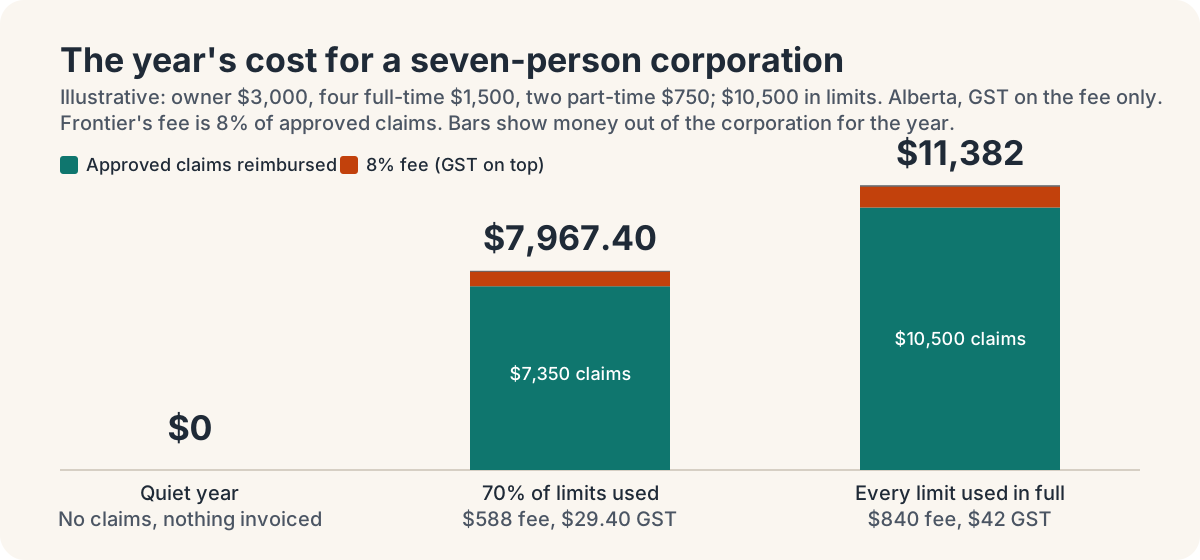
Suppose the team uses 70% of its limits, which is $7,350 in approved claims, and the corporation is in Alberta, where GST applies to the administration fee only.
- Claims reimbursed: $7,350
- Frontier fee, 8% of approved claims: $588
- GST on the fee: $29.40
- Total for the year: $7,967.40
In a quiet year with no claims, the corporation pays $0. If every person claims their full limit, the corporation pays $10,500 in claims, an $840 fee and $42 GST, for $11,382. The cost scales with what your people actually use, which is the point of this structure for a small team.
Ontario corporations also pay retail sales tax and the premium tax on this kind of plan; our post on HSA taxes by province has the rates, and the true cost of an HSA works through a full example.
How the published fees compare for this team
These are published administration fees, before tax, checked November 9, 2026. They are the charges on top of the $7,350 in claims, which the corporation pays under every provider. Fee types are listed separately because a team of seven pays them differently from a one-owner plan.
- Frontier HSA: 8% of approved claims, no setup, annual or per-employee fee. Year one on $7,350: $588.
- Coastal HSA: 7% plus a one-time $50 setup fee. Year one: $564.50, then $514.50 a year at the same claims. Coastal collects the claim, fee and tax by pre-authorized debit.
- Olympia Group HSA: 8% plus a $335 setup fee, a $99 annual fee and $40 per member added. For seven members, year one is $588 plus $335, $99 and $280, which is $1,302, then $687 a year. Olympia's $249 Basic plan is its flat-fee owner plan; the Group HSA is the offer priced for staff. The year-one total assumes no members are added after setup.
- EasyHSA: 10%, no setup or annual fee. Year one: $735.
- Wellbytes Pay-As-You-Use: 10%, no setup fee. Year one: $735.
- Kibono: $2.25 plus 5.25% per claim, plus payment processing of $1.50 plus 1.50% for debit or $0.30 plus 3.50% for cards. The total depends on how many claims the team files, so work it out on your own claim count.
- Quikcard: no signup fee and "typically" 12%; other charges are confirmed in a quote, so we do not give a total.
- myHSA and Canada Life HCSA: quote required. We cannot give a total for a seven-person team from their published pages.
| Provider | Setup | Annual | Per member | Claim fee | Year-one fee on $7,350 | Best for |
|---|---|---|---|---|---|---|
| Frontier HSA | $0 | $0 | $0 | 8% | $588 | No fixed fees, nothing upfront |
| Coastal HSA | $50 | $0 | Confirm | 7% | $564.50 | Steady claims above $5,000 a year, paid by debit |
| Olympia Group | $335 | $99 | $40 | 8% | $1,302 | Groups also comparing Olympia's flat-fee owner plan |
| EasyHSA | $0 | $0 | $0 | 10% | $735 | Employers checking non-corporate eligibility |
| Wellbytes Pay-As-You-Use | $0 | $0 | Confirm | 10% | $735 | Comparing a percentage fee against an annual quote |
| Kibono | $0 | $0 | Confirm | $2.25 + 5.25% | Depends on claim count | Teams that compare on claim count as well as dollars |
| Quikcard | $0 | Confirm | Confirm | Typically 12%; confirm | Confirm | Phone and chat support |
| myHSA, Canada Life HCSA | Quote | Quote | Quote | Quote | Quote required | Advisor-led or insurer-bundled benefits |
Said plainly: Coastal is cheaper than Frontier on administration fees above $5,000 of claims in year one, and at any claim volume after the setup year. A team with steady claims above that should compare it seriously. Among the percentage-only published rates (Coastal, Olympia Group, EasyHSA and Wellbytes), Frontier is the cheapest below $5,000 of claims in year one, and it has no per-member or annual line at any volume. Kibono's per-claim pricing can come in lower for a team that files few claims, so work it out on your own count. Sources are the linked pricing pages; the "best for" column is our reading of each offer, not a ranking.
Who pays the employee, and when
The order matters for a small team, because the person waiting for money sits ten feet from the person paying the invoice.
With Frontier, an employee submits a receipt and we review it against the CRA's eligible expense rules. After approval, Frontier invoices the corporation for the claim, the fee and taxes. With automatic bank payments turned on, which is a pre-authorized debit verified once with two small deposits, the employee is paid as soon as the debit starts. With manual invoices, the employee is paid once the corporation pays the invoice. We do not promise a number of days, because bank timing is not ours to promise.
For a team of 5 to 10 we recommend turning on automatic payments, so nobody waits on accounts payable. Our post on setting up an HSA without upfront funding explains why this works without a deposit.
Running it with one admin
The admin sets the classes and limits once and invites staff. Staff create their own accounts, submit receipts and follow their claims in their own view. The admin pays the invoices. A new hire is added to a class; a leaver is removed. There are no payroll entries, because approved reimbursements under a qualifying plan are not taxable income to the employee.
Frontier's how it works page shows each step. Frontier has no contract and no cancellation fee, and no minimum headcount, so a team of five that shrinks to three is not stuck.
Where another option fits better
An HSA is not always the right answer for a team this size, and it helps to know the cases before you pick a provider.
- Your team needs life, disability or travel cover. An HSA reimburses expenses; it does not insure anyone. A group plan with a Health Care Spending Account inside it gives you both, at a premium.
- Someone has heavy, predictable drug costs. Insurance for that line can cost less than reimbursing it in full every year. Our comparison of HSA versus insurance works through it.
- Claims are steady and well above $5,000 a year. On administration fee alone, Coastal's lower percentage wins after year one. Check its other terms, then decide.
- The corporation is in Quebec, or the business is a sole proprietorship. Frontier does not serve either. Quebec treats HSA reimbursements as a taxable benefit provincially, and sole proprietors face their own limits under the CRA rules. Other providers have their own eligibility pages; read them before comparing price.
What we recommend
For a Canadian corporation of 5 to 10 employees outside Quebec with uneven claims, we recommend a pay-per-claim HSA with limits by employee class, dependants included, automatic bank payments on, and no contract. Frontier charges 8% of approved claims and nothing else, with nothing upfront. On the seven-person plan above, that is $588 in fees on $7,350 of claims, and $0 in a quiet year. Owner eligibility as a shareholder-employee is reviewed before the plan starts; check your eligibility first. Look elsewhere in two cases: steady claims above about $5,000 a year compared on fee alone, where Coastal costs less, and a team that needs insurance alongside the account, where a group plan with an HCSA fits.
FAQ
What limit should I set for a team of seven?
Pick a limit you would be comfortable paying in full for every member, with a higher owner class where the business can support it; the example above uses $750 to $3,000. With Frontier, increases apply right away, and once the plan is in use decreases take effect at the next plan year. Ask your accountant to confirm the amounts.
Can the owner have a higher limit than staff?
Yes, if the owner is an employee who works in the business and sits in a class defined by an employment reason, such as owner-manager versus staff. The limit must be reasonable for the role. A shareholder who holds shares but does no work does not qualify; Frontier reviews owner eligibility before the plan starts.
Do part-time employees have to be included?
No. You can define the plan around full-time staff, or create a part-time class with a lower limit. Whatever you choose, every employee in the same class gets the same limit, and the reason for leaving a group out or giving it less must be about employment, not about the person. Document the reason.
Is an HSA cheaper than group insurance for 5 to 10 people?
Usually, if your team mainly needs dental, vision, paramedical and prescription coverage, because you pay only approved claims and a fee. It is not cheaper if the team also needs life, disability or travel insurance, which an HSA does not provide. Price both against the claims you expect and the protection you need.
Do I need an HR person to run it?
No. With a pay-per-claim provider the admin's job is to set classes and limits once, invite staff, add and remove people as they come and go, and pay the invoices. Staff submit receipts themselves and follow their own claims. There are no payroll entries, because reimbursements under a qualifying plan are not taxable income to the employee.
What if someone joins or leaves mid-year?
The admin adds the new hire to a class and removes the leaver; that is the whole task. Whether a mid-year joiner gets the full limit or a prorated share depends on how the class is set up, so decide that when you design the plan. Ask any provider how claims dated before a departure are handled. Frontier charges no per-member fee for either change.